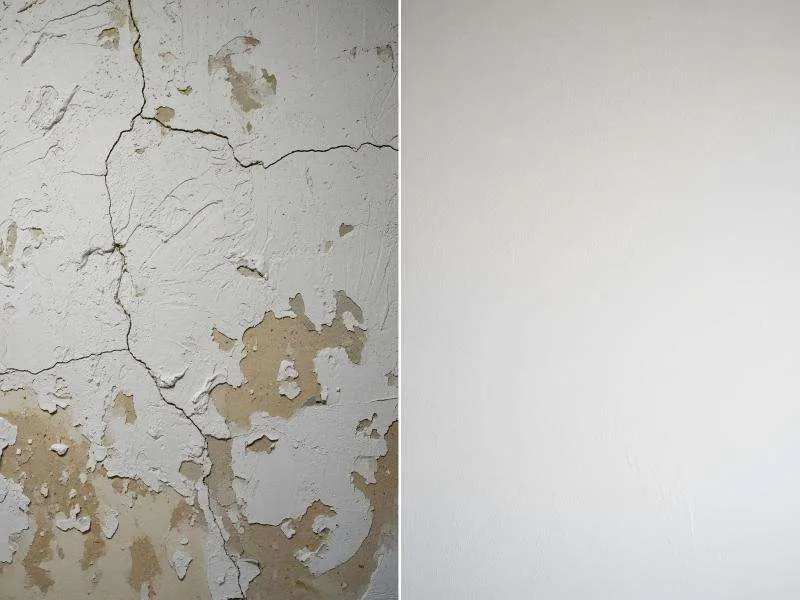
Wall scraping putty can make the wall more delicate, the flatness is higher than the cement wall, so that the wall painting effect is better, but also saves paint. However, if the putty layer produces cracks, it is easy to cause the surface layer to crack. Why is the putty layer prone to cracking?

Improper construction
Scraping too thick
If the putty is too thick, the drying and curing process will be easy to occur, resulting in dry cracks. Especially if the ceiling wall putty is too thick, under the action of gravity is prone to fall, hollow drum and cracking. Therefore, the putty must not be a single batch of scraping too thick, it should be thin batch of multiple times.
Usually, it is recommended that each scraping thickness of less than 1.5mm, scraping interval should not be more than 3 days, so as to ensure that each time can be dry.
Not dry before the next process
Grass-roots treatment, patching and patching material is not completely dry, above the scraping hardness of the interior wall putty, easy to cause cracking. If the bottom layer of putty is not dry, dry the surface layer first, which will cause the drying and shrinking degree between layers is not the same, easy to crack.
Mixed with other materials
Qualified putty produced by formal brands, the ingredients have been layers of tests, tests, and finally formed a scientific proportion ratio, construction only according to the construction instructions on the packaging, should not be mixed with other materials. If you mix other materials without authorization, it may change the original performance of the putty, affect the crack resistance of putty, and cause the putty layer to crack.
Environmental reasons
After scraping the putty, if the ventilation is too strong (for example, after scraping the putty and blowing “through the wind”), the putty layer is not dry inside the surface dry, easily causing dry cracks. For example, summer high temperatures, putty layer dries faster, if blowing through the wind, water loss too fast, there will be shrinkage deformation, cracking may be. Therefore, after scraping putty, it should be properly ventilated to keep the putty layer naturally dry and cured.
Product quality reason
Another reason for putty layer cracking is the quality of the material itself. Especially the quality of hydroxypropyl methylcellulose, if the selection of low-quality water retention rate of low hydroxypropyl methylcellulose, will cause putty drying too quickly, not fully hydrated to reach a certain strength, resulting in cracking. Some putty itself anti-cracking performance is poor, a little batch of thicker is also prone to cracking itself.
In addition to putty and putty construction reasons for putty layer cracking, there are structural cracking of the wall, grass-roots level of hollow drums, cement mortar layer cracking, cracking at the joints and other grass-roots level reasons will also cause putty layer cracking. The structural cracking of the wall should be dealt with by professional architects, while other grass-roots causes should be checked and effectively dealt with before putty scraping, so as to control the cracking of the putty layer from the source.
Recommended reading: hpmc for putty
Basic treatments to prevent putty cracking
Substrate treatment
Old houses are subjected to external impact and vibration in long-term use, which may cause local wall base and wall detachment. If in the second decoration of the wall, did not remove the original old wall siding, or only shoveling the surface layer of putty, will leave an uneven part of the siding. If you putty on the wall thereafter, it is likely to lead to cracking of the newly painted wall.
Interface agent thickness
When the old wall surface is treated, no interfacial agent is applied, or the interfacial agent is too thin, and after the change of indoor humidity, the wall skin will appear to be hollow and drum, and then cracks will occur and fall off.
Putty thickness
If the putty layer is too thick, the wall will be easy to fall off in the future. Wall paint putty generally to batch 2 to 3 times, each putty thickness of not more than 2 mm, and dry before batching the next one.
Dry treatment
When dealing with the base of the wall, the air humidity is higher than 70% can not be batch putty step. If the moisture content is too large and without drying treatment, directly putty or wall paint on the brush, each layer of different materials, drying speed is different, once the temperature rises will be due to the degree of contraction of the different wall layer caused by cracking.
Material ratio
Improper proportion will affect the toughness and tension of the wall. The ratio of cement and sand in the base plaster should be 1:3, and the addition of hydroxypropyl methylcellulose is 4-5 kilograms, which is easy to crack if the ratio is high. The ratio of wall putty, latex paint and water should be found.
For putty that has cracked, it is recommended to shovel it. If the cracks are not too big, flexible putty can also be used for the first course of construction, and then constructed according to the standardized construction method. Each construction should not be too thick, the former putty thoroughly dry before the latter scraping.