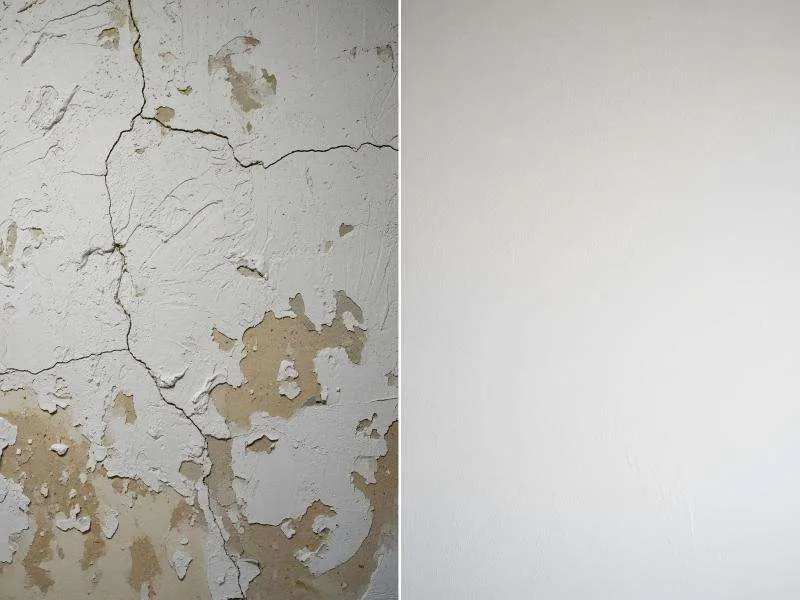
Conventional mortars, which are primarily composed of cement, sand and water, have poor adhesion to modern substrates and are brittle after curing, which are problems for contractors and quality issues for building owners. Introducing HPMC and RDP as additives into building formulations can solve these problems.

HPMC: Water Management Expert
HPMC is extracted from cellulose through chemical modification, and its unique molecular structure contains hydrophilic and water-repellent parts, which has excellent performance in cement-based systems.
HPMC products prevent the mortar from drying out prematurely by binding water molecules in the mixture. But water retention is only the beginning of HPMC’s contribution. The viscosity it imparts improves the “stickiness” of the mortar on vertical surfaces without affecting workability. It allows the mortar to flow smoothly during application, preventing sagging in traditional formulations.
HPMC forms a temporary bond between cement particles during the early hydration stage, preventing material separation and ensuring a more uniform cure throughout the mortar mass.
Regarding the hydroxypropyl methyl cellulose for mortar, you can click “hydroxypropyl methyl cellulose for mortar” to view
RDP: A combination of flexibility and strength
While HPMC excels at controlling fresh mortar properties, RDP changes the properties of the cured material. Unlike most building additives, RDP undergoes a fascinating transformation during use, from powder to liquid polymer emulsion and back to a solid polymer film.
This redispersibility is what makes RDP unique. During mixing, the powder reverts to its original emulsion form, dispersed throughout the mortar. As water evaporates during curing, these polymer particles coalesce to form a continuous film, interwoven with the crystalline cement structure.
The resulting composite combines the compressive strength of cement with the flexibility of polymer. RDP also enhances adhesion, which is especially valuable when dealing with challenging substrates such as existing tile, waterproofing membranes or insulation boards. Without RDP-modified adhesives, installing modern tiles on difficult surfaces would be nearly impossible.
After RDP modification, water resistance is greatly improved, but the material remains breathable, allowing vapor transmission while resisting liquid water penetration.
Regarding the applications of redispersible polymer powder, you can click “applications of redispersible polymer powder” to view
Proper Selection of HPMC and RDP
The selection of HPMC involves evaluating many parameters, including viscosity, type and degree of substitution, particle size distribution, and dissolution rate. These factors directly impact workability duration, sag resistance, and compatibility with other ingredients.
The selection of RDP focuses on polymer composition, minimum film-forming temperature, glass transition temperature, and protective colloid system. These properties determine flexibility, water resistance, and long-term durability.
Dosage optimization is another key consideration. HPMC typically comprises 0.1-0.5% of the dry mortar weight, while RDP ranges from 1-5%, depending on performance requirements. The optimum point varies depending on application conditions, substrate characteristics, and performance expectations.
The chemistry becomes more complex when interactions with cement grades, aggregate grading, and other additives are considered. A formulation that performs well under laboratory conditions may fail in the field if these interactions are not properly understood.